

A French employers’ organisation in the metallurgy and metal processing sector, this client – with 50 employees – decided, at the end of 2025, to migrate its on-premises infrastructure to the Azure cloud. The aim: To migrate ten Linux and Windows servers (Debian 8/11, Ubuntu 24.04, Windows Server 2019) hosting its web portals and CMS, its document generation system, its PostgreSQL database and its shared application services. Carried out using Azure Migrate and hosted in the Central France region, this migration took place from the kick-off on 8 December 2025 until the on-premises environment was fully decommissioned at the end of March 2026.
The customer
This client is a French employers’ organisation representing companies in the metallurgy and metalworking sectors. Its information system had historically been hosted on the environment VMware Cloud Temple’s on-premises environment, protected by a cluster of firewalls, with an architecture segmented into zones (Production, Pre-production, DMZ).
The background and the issues at stake
The client approached Cloud Temple to migrate its entire IT system to Microsoft Azure. The project is being carried out in two stages: an initial phase of rehost (lift and shift) to quickly secure and stabilise existing applications without having to undertake a technical overhaul, followed by a modernisation roadmap (refactoring to PaaS databases, containerisation and microservices).
The scope of the rehosting project covered ten servers, spread across the Production and Pre-production environments of the client’s application portals: seven Linux servers hosting web portals and CMS, a document generation service, a PostgreSQL database and shared application services, as well as three Windows Server servers.
The Cloud Temple solution
Methodological approach
The project followed a structured approach in line with the best practices of the Cloud Adoption Framework (CAF):
- Assess — Deployment of an appliance Azure Migrate directly into the source VMware environment and carrying out a comprehensive assessment of the ten source servers (operating system, configuration, application dependencies).
- Migrate — Continuous replication of on-premises workloads to Azure, followed by a test run of the replicated VMs (dry run), and a phased, batch-by-batch switchover (Non-Production then Production) to minimise risk to critical portals.
- Secure — Securing the web entry point using an Application Gateway combined with a WAF, which was not part of the legacy on-premises architecture.
- Operate — Granting of administrative rights via Azure Lighthouse, based on a model of shared collaboration between the client and Cloud Temple.
- Decommission — Decommissioning of the relevant on-premises infrastructure at the end of March 2026, following validation of the switch to production.
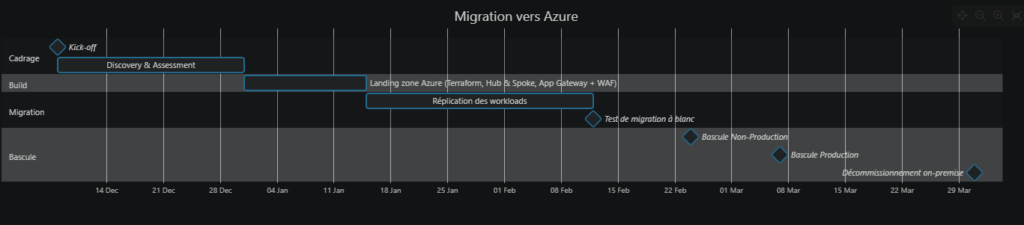
Project phasing
The project was carried out in just under four months, from the kick-off to the decommissioning of the on-premises system:
From on-premises infrastructure to Azure architecture
The diagram below illustrates the transformation carried out: the Production and Non-Production servers, hosted on the environment VMware Cloud Temple’s on-premises environment was migrated to Azure via Azure Migrate, ending up in an Azure landing zone secured by an Application Gateway paired with a WAF.
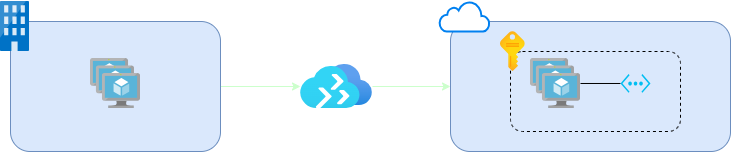
Migration completed in the Azure region Central France, without changing the OS version (identical rehosting), whilst maintaining application compatibility with existing portals.
Azure landing zone built using Infrastructure as Code
The target Azure environment was not configured manually: it was created by Terraform, deployed via a CI/CD pipeline, based on an architecture Hub & Spoke. The naming of resources and the organisation into separate subscriptions for the network, management and applications follow the conventions of the Cloud Adoption Framework (CAF). The Azure Lighthouse administration permissions assigned to Cloud Temple are themselves versioned in Terraform.
The results
- ‘Lift-and-shift’ migration of 10 servers (Linux and Windows) without changing the OS version, whilst maintaining application compatibility with existing portals
- Securing the web entry point by implementing a Application Gateway + WAF, which is absent from traditional on-premises architecture
- The cutover is managed through the systematic validation of a dry run migration test prior to cutover, and by sequencing the Non-Production and then Production environments to minimise business risk
- Complete decommissioning of the relevant on-premises infrastructure by the end of March 2026
- Azure governance shared between the client and Cloud Temple via Azure Lighthouse
Why Cloud Temple?
This project demonstrates Cloud Temple’s ability to support a client hosted on a private cloud in a ‘lift-and-shift’ migration of its Linux and Windows environments to Microsoft Azure, using a phased and secure migration methodology. This represents the first step in a broader modernisation journey towards PaaS and containerised architectures.