


A French consultancy firm with 50 staff members, this client began migrating its Active Directory infrastructure to Azure in early July 2025. The challenge was to migrate its Windows Server domain controllers – the critical foundation for the firm’s authentication and identity management – from a source VMware environment to the cloud. Carried out using Azure Migrate via an appliance deployed on the existing infrastructure and hosted in the Central France region, this migration spanned from the kick-off on 3 July 2025 until the complete decommissioning of the on-premises environment on 15 December 2025.
The customer
This client is a consultancy firm whose IT system had historically been hosted on Cloud Temple’s private cloud infrastructure. As a long-standing client, it decided to migrate its infrastructure to the public cloud whilst retaining Cloud Temple as its managed services partner. The project forms part of a merger with a sister company, whose IT system is set to be integrated into the client’s single Azure tenant.
The background and the issues at stake
The client has hired a Full Move to Cloud the move to Microsoft Azure was driven by four objectives: to strengthen the overall security of the information system through the implementation of a SIEM, to upgrade the existing infrastructure by migrating all services to the Azure Cloud, to maintain high availability and optimal performance by merging the IT systems of the two entities, and to facilitate the administration of workstations via Intune. It therefore asked Cloud Temple to lead the migration and to remain the sole operator authorised to manage the Azure resources once the project was complete, thereby ensuring continuity of operational maintenance (MCO) and security (MCS).
The technical scope combined two complementary approaches: one rehost using a ‘lift and shift’ approach for components that do not require a redesign – such as Active Directory domain controllers (a scenario documented in this case study) – and the complete reconstruction several servers directly in Azure (monitoring and log collection, network monitoring, business applications), where starting afresh on a clean slate was more appropriate than a straightforward ‘lift and shift’ approach.
The Cloud Temple solution
Methodological approach
The project followed a structured approach in line with the best practices of the Cloud Adoption Framework (CAF):
- Assess — Deployment of a Azure Migrate appliance directly within the source VMware environment and carrying out a comprehensive assessment of the candidate servers, including Azure sizing and a budget estimate.
- Migrate — Migration via lift and shift Active Directory domain controllers via Azure Migrate, with the network addressing plan replicated exactly to ensure there is no impact on applications or users, supplemented by the native reconstruction of several ancillary services (monitoring, asset management, business tools) directly in Azure.
- Secure — Integration of security monitoring via Azure Sentinel from the moment the system goes live.
- Operate — Granting of administrative rights via Azure Lighthouse, with, at the client’s request, Cloud Temple granted exclusive management rights over all Azure resources.
- Decommission — Formal handover to the client, followed by the decommissioning of the relevant on-premises servers on the Temple Cloud infrastructure.
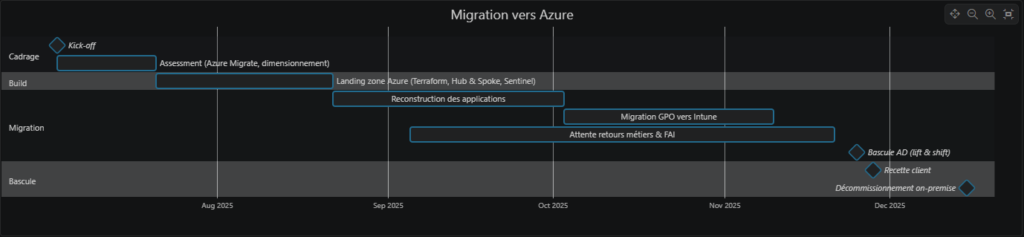
Project phasing
The project was carried out in just over five months, from the kick-off to full go-live:
From on-premises infrastructure to Azure architecture
The diagram below illustrates the transformation carried out: the domain controllers, hosted on the environment VMware Cloud Temple’s on-premises infrastructure was migrated to Azure using Azure Migrate, whilst the associated services were rebuilt natively within the same landing zone.
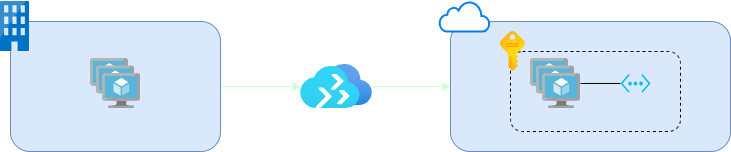
Migration completed in the Azure region Central France, in accordance with the client’s data sovereignty and localisation requirements, and taking advantage of the Azure Hybrid Benefit to optimise Windows Server licensing.
Azure landing zone built using Infrastructure as Code
The target Azure environment was not configured manually: it was created by Terraform, deployed via a CI/CD pipeline, based on an architecture Hub & Spoke. Resource naming and the tagging scheme follow the conventions of the Cloud Adoption Framework (CAF). The Azure Lighthouse administration permissions assigned to Cloud Temple are themselves versioned in Terraform.
The virtual machines resulting from the rehost have been imported into the Terraform state after they have been migrated via the Azure Migrate appliance, so that they are managed to the same standards as the rest of the customer’s Azure infrastructure — rather than as isolated resources created outside the IaC framework.
The results
- Virtual machines migrated without any disruption to service; the existing network remained unchanged
- Complete decommissioning and mapping of the corresponding on-premises infrastructure following client approval
- A formal acceptance certificate signed by the client, confirming the successful completion of all project activities
- Integration of security monitoring (Azure Sentinel) as soon as the migration to Azure takes place
- Simplified governance for the customer: a single point of contact (Cloud Temple) authorised to manage the Azure environment via Azure Lighthouse
Why Cloud Temple?
This project demonstrates Cloud Temple’s ability to support a client already hosted on a private cloud in their transition to the Microsoft Azure public cloud, whilst maintaining continuity of managed services and applying a migration methodology aligned with the Cloud Adoption Framework, from the initial assessment through to post-migration operational support.